The Optical Illusion: Architecture without Construction
In 2026, interior design has embraced the ‘Illusion of Space.’ With urban living becoming more compact, we are using **Refractive Strategy** to ‘trick’ the human eye into perceiving depth where none exists. A mirror is no longer just a functional object for checking your reflection; in 2026, it is an **’Architectural Portal.’**
Used correctly, a mirror can double the perceived square footage of a room, boost natural light by 40%, and create a sense of ‘flow’ in even the most cramped apartments. Here is the 2026 masterclass on mirror placement.
1. The ‘Window-Mirroring’ Technique
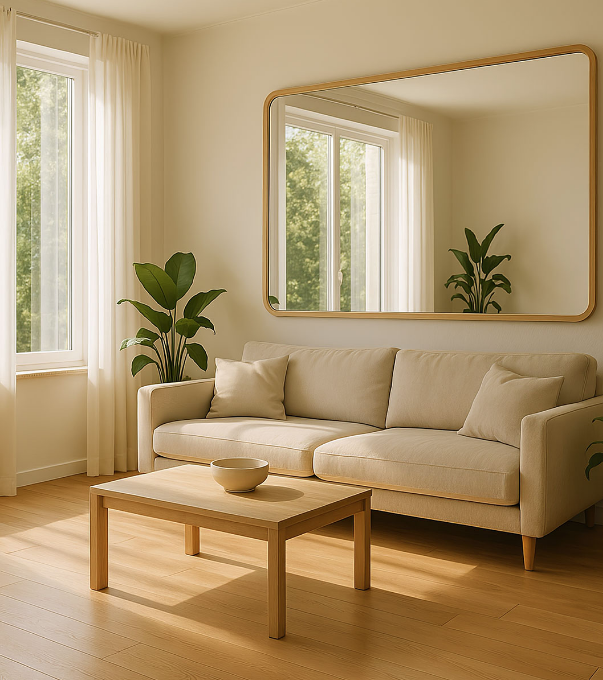
The #1 rule for 2026 space-hacking is to **place your mirror adjacent to—not opposite—a window.** While placing it opposite a window reflects the light, placing it on an adjacent wall creates the ‘Double Window’ effect.
When you catch the view of the outdoors at an angle, the brain struggles to identify where the wall ends and the ‘outside’ begins. This ‘Blurs the Boundary’ of the room. In 2026, we are also seeing a rise in **’Window-Pane Mirrors’**—mirrors with frames that mimic the mullions of a window. When hung correctly, these look exactly like an additional portal to the outside world, instantly curing that ‘closed-in’ feeling.
2. The ‘Floor-to-Ceiling’ Lean
Small rooms often feel ‘short.’ To combat this, 2026 designers use **Vertical Elongation.** An oversized, arched floor mirror that leans against the wall (rather than being hung) draws the eye upward.
The secret here is to ensure the mirror is at least 6 feet tall. In 2026, the ‘luxury’ look is a **Thin-Profile Brass Frame.** The leaning angle creates a ‘forced perspective’ that makes the ceiling appear higher than it actually is. It also creates a ‘visual anchor’ for the room, making a small space feel ‘grand’ and intentional rather than cluttered.
3. The ‘Infinity’ Kitchen Backsplash
The kitchen is often the most cramped room in the house. In 2026, we are replacing traditional tile backsplashes with **Smoked Mirror Glass.**
Standard mirrors can feel too ‘bright’ and clinical in a kitchen. A ‘Smoked’ or ‘Antiqued’ mirror backsplash adds depth and a ‘moody’ luxury feel while effectively doubling the perceived depth of your countertops. It also allows you to keep an eye on the rest of the room while you’re prepping food—perfect for the ‘open-concept’ lifestyle of 2026. Because it’s a continuous surface, it also eliminates the ‘visual noise’ of grout lines, making the wall feel ‘infinite.’
4. Grouping: The ‘Gallery of Light’
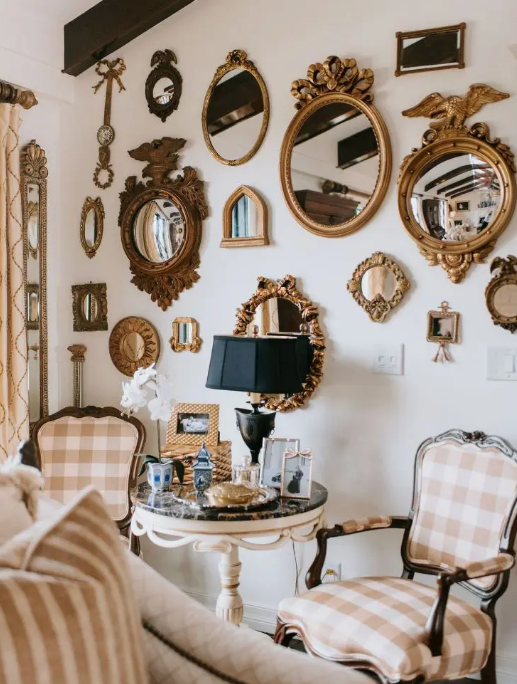
If you don’t want one giant mirror, the 2026 alternative is the **Mirrored Gallery Wall.** Instead of art, hang a collection of smaller mirrors in varying shapes and sizes.
The trick is to keep the frames within the same **Earth-Tone Palette** (see our previous post on Earth Tones!). This creates a ‘faceted’ reflection. Each mirror catches a different part of the room, breaking up the walls and creating a ‘shimmer’ effect that feels airy and light. This is particularly effective in dark hallways where a single large mirror might feel overwhelming.
Summary: Reflecting Your Potential
Using mirrors in 2026 is about ‘Spatial Mindfulness.’ You aren’t just decorating a wall; you are managing the way light and depth interact with your daily life. By strategically placing portals of reflection, you can turn a 500-square-foot apartment into a ‘Luminous Sanctuary.’ Remember: the eye believes what it sees, so give it something beautiful to look at—twice.