Photography in 2026: Beyond the ‘Smartphone Filter’
We’ve entered a new era of travel photography. In 2026, the ‘Snap and Post’ culture has been replaced by **’Digital Storytelling.’** With smartphone cameras now featuring 1-inch sensors and mirrorless cameras utilizing ‘Neural-AF’ (autofocus that can track a bird’s eye at 100 yards), the barrier to entry has never been lower—but the bar for quality has never been higher.
To stand out in the 2026 visual landscape, you need more than a high-resolution sensor; you need an ‘Eye for Narrative.’ This 1,200-word masterclass will take you from a ‘Tourist with a Camera’ to a ‘Travel Photographer.’
1. Master the ‘Rule of Thirds’ and Beyond
Most beginners place their subject right in the center. In 2026, we call this the ‘ID Badge’ shot—it’s functional, but boring. Instead, use the **Rule of Thirds**. Imagine your frame is divided by two horizontal and two vertical lines. Place your subject on one of the four ‘Intersection Points.’
But don’t stop there. In 2026, we look for **’Leading Lines.’** Use a path, a fence, or even the curve of a shoreline to ‘lead’ the viewer’s eye into the distance. This creates **Depth**. Another 2026 favorite is **’Framing within a Frame.’** Shoot through an archway, a window, or even some overhanging leaves to ‘bracket’ your subject. This gives your photos a professional, ‘editorial’ feel that is synonymous with 2026 travel magazines.
2. The ‘Golden Hour’ vs. The ‘Blue Hour’
Light is the ‘Raw Material’ of photography. In 2026, we avoid the ‘Midday Sun’ at all costs. It creates harsh shadows and ‘blown-out’ highlights.
**The Golden Hour:** The hour after sunrise and before sunset. The light is soft, warm, and low-angle, creating beautiful long shadows that add ‘texture’ to landscapes.
**The Blue Hour:** The 20-minute window *before* sunrise and *after* sunset. The sky turns a deep, electric blue, and city lights start to pop. In 2026, with our improved ‘Low-Light’ sensors, the Blue Hour is where you get those ‘Dreamy’ cityscapes. Use a small ‘Travel Tripod’ during this time to keep your ISO low and your images ‘Noise-Free.’ This is the ‘Secret Sauce’ of the 2026 pro.
3. The ‘Human Element’ and Ethical Street Photography
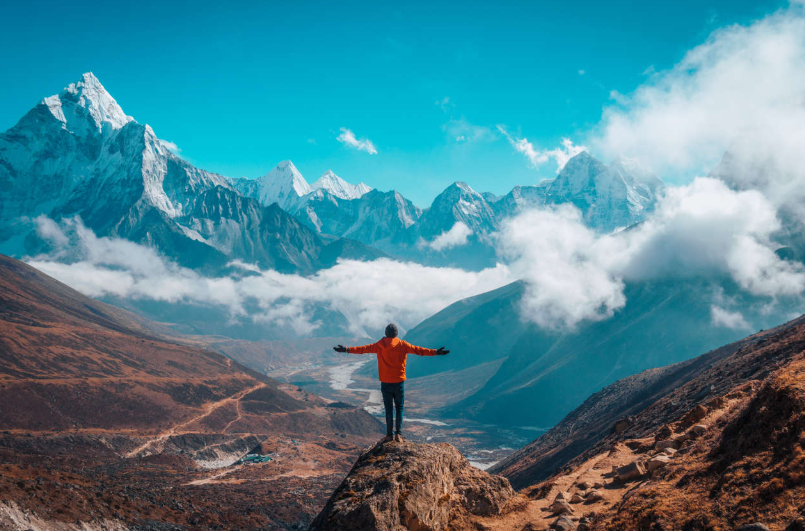
A landscape without a person can feel ‘Stale.’ In 2026, we use the **’Human Element’** to provide **Scale**. A photo of a mountain is impressive; a photo of a person sitting on the edge of that mountain is ‘Epic.’
However, in 2026, we are very conscious of **’Ethical Photography.’** Don’t just take photos of people in foreign countries like they are ‘objects.’ Engage with them. Ask for permission (a smile and a gesture toward the camera usually works). If you can, show them the photo afterward. In 2026, ‘Candid’ doesn’t mean ‘Secretive.’ Capturing a genuine interaction or a local artisan at work tells a story of a culture, not just a place. This is the heart of ‘Travel Storytelling.’
4. Tech Check: Prime Lenses and ND Filters
If you are moving beyond your phone in 2026, your first investment should be a **’Prime Lens’** (a lens that doesn’t zoom, like a 35mm). Why? Because prime lenses have wider apertures (f/1.8), which allow you to create **’Bokeh’**—that beautiful blurred background that makes your subject ‘pop.’
Your second investment should be a **Circular Polarizer (CPL)** or a **Neutral Density (ND) Filter**. In 2026, we use CPLs to remove the ‘glare’ from water and to make the sky a deeper blue. ND filters are ‘Sunglasses’ for your camera, allowing you to use a slow shutter speed even in bright light. This is how photographers get that ‘Silky’ look on waterfalls or the ‘Motion-Blur’ in a crowded market. These are ‘Analog’ effects that AI-filters still can’t perfectly replicate.
5. Post-Processing: The ‘Analog-Digital’ Mix
In 2026, we’ve moved away from ‘Over-Saturated’ HDR looks. The current trend is **’Cinematic Realism.’** When editing in 2026 apps (like Lightroom-AI), don’t push the ‘Saturation’ slider; instead, use **’Color Grading.’**
Add a touch of ‘Teal’ to the shadows and ‘Orange’ to the highlights to create a professional cinematic look. Use the **’Texture’ and ‘Clarity’** sliders sparingly—too much makes a photo look ‘crunchy.’ In 2026, we also ‘Denoise’ using AI-models, which can turn a grainy night-shot into a clean masterpiece. The goal of editing is to make the photo look like how you *remembered* the moment, not how the camera sensor ‘saw’ it.
Summary: Capture the Feeling, Not the Sight
Travel photography in 2026 is about **Emotion.** It’s about capturing the ‘Vibe’ of a morning in Paris or the ‘Power’ of a storm in the Andes. By mastering composition, understanding the ‘Two Hours’ of light, and using your tech wisely, you can move past ‘Vacation Photos’ and create ‘Art.’ Don’t just take photos; tell stories. Your future self will thank you for the memories.