Resin Art 2026: The Eco-Resin Revolution
Resin art has undergone a massive transformation in the last few years. In 2026, we have moved away from the toxic, ‘yellowing’ epoxies of the past. The modern artist uses **Bio-Derived Resins** made from soybean or sunflower oil. These are VOC-free, BPA-free, and offer a level of UV-resistance that was previously impossible.
For the 2026 beginner, resin isn’t just a ‘coating’; it’s a sculptural medium. Whether you are creating ‘Functional Art’ like coasters or ‘Fine Art’ like geode wall hangings, the key is understanding the **Chemistry of the Cure.** This is your 1,000-word masterclass in fluid creativity.
1. The ‘Safety First’ Setup (The 2026 Standard)
Even with bio-resins, safety is non-negotiable. Resin is a chemical reaction. When you mix Part A (Resin) and Part B (Hardener), you create an **Exothermic Reaction**—it literally generates heat.
In 2026, your ‘Home Studio’ must have:
– **Nitrile Gloves:** Latex will dissolve under resin exposure.
– **Silicone Mats:** Resin does not stick to silicone. Once it cures, it peels right off, making cleanup effortless.
– **Leveling App:** Use your 2026 smartphone’s ‘Level’ tool. If your table is even $1^{circ}$ off, your resin will ‘slump’ to one side, ruining your design.
2. Idea #1: The ‘3D Ocean’ Pour
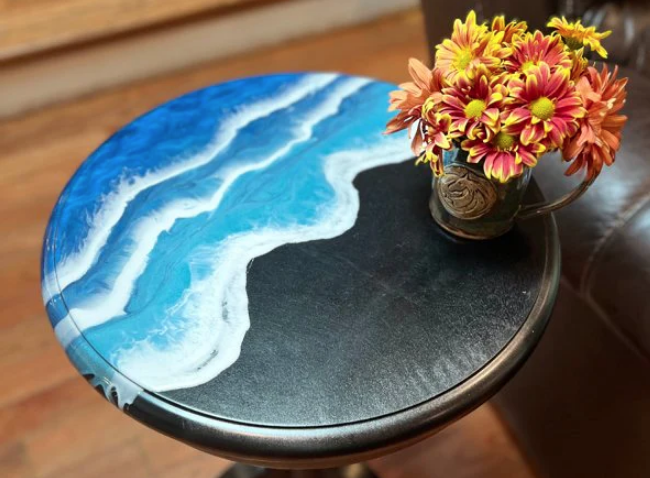
The ‘Ocean Pour’ is the most iconic resin technique, and in 2026, we’ve perfected the **’Lacing’ effect.**
**The Technique:** Pour a gradient of blues (Deep Navy to Turquoise) onto a wooden ‘Cradle Board.’ At the ‘shoreline,’ pour a thin line of white resin mixed with **Cell-Distributor.** Use a heat gun or a hair dryer on ‘Cool-High’ to push the white resin over the blue. The heat breaks the surface tension, creating ‘cells’ that look exactly like sea foam. To add a 2026 twist, imbed **Real Sand and Crushed Shells** into the first layer. Once cured, pour a second clear ‘Deep Sea’ layer on top to create incredible 3D depth.
3. Idea #2: Botanical Preservation in ‘Pyramids’
With the ‘Slow Living’ movement of 2026, preserving wedding bouquets or garden flowers in resin has become a major trend. The secret to success is **Silica Gel Desiccation.**
You cannot put fresh flowers in resin—they will turn brown and rot inside the plastic. First, bury your flowers in silica gel for 7 days to remove 100% of the moisture while keeping the color. Place the dried flower into a silicone ‘Pyramid Mold.’ Pour the resin in **1-Inch Layers.** If you pour the whole pyramid at once, the heat of the exothermic reaction can ‘cook’ the flower, turning it yellow. This ‘Multi-Day Pour’ ensures a crystal-clear, heirloom-quality result.
4. Idea #3: The ‘Galaxy’ Geode with Eco-Glitter
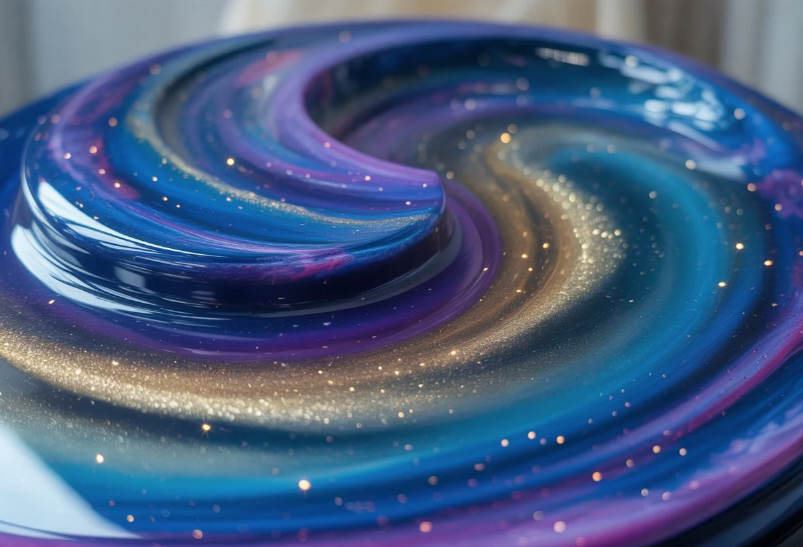
In 2026, we have banned micro-plastic glitters. We now use **Mica-Based and Cellulose-Glitter.** To create a ‘Galaxy Geode,’ you will use **Alcohol Inks** and ‘High-Viscosity’ resin.
Draw a ‘Geode’ shape on a piece of glass. Pour your resin, then drop the alcohol inks into the wet mixture. Because the resin is thick, the ink won’t mix completely; it will stay in ‘tendrils’ and ‘blooms.’ Sprinkle your eco-glitter and crushed quartz along the edges. The result is a piece of art that looks like a slice of a distant planet. It’s a favorite for 2026 ‘Modern-Industrial’ interiors.
Summary: Mastering the Flow
Resin art is a lesson in letting go. You can control the colors and the placement, but once the chemical reaction starts, the resin has a mind of its own. In 2026, we embrace this ‘Chaos within Structure.’ Whether you are making jewelry or large-scale tables, the beauty is in the imperfections. Start small, respect the chemistry, and let your creativity cure into something permanent.