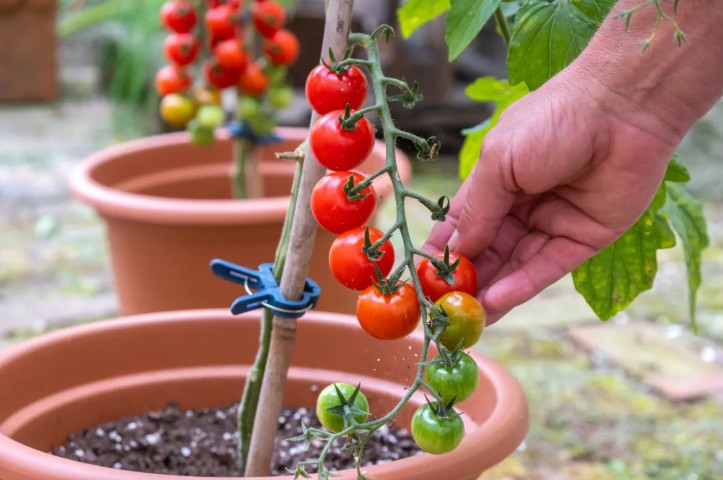
The ‘Urban Farm’ 2026: Verticality and Resilience
With food prices fluctuating in 2026, ‘Container Gardening’ has shifted from a hobby to a high-yield strategy for city dwellers. You don’t need an acre of land to produce 50 lbs of tomatoes; you just need a 5-gallon pot and an understanding of **Micro-Climates.** This 1,200-word guide covers the 2026 methods for high-output, low-effort tomato growing.
Step 1: Selecting the ‘Right’ Genetics
In 2026, we categorize tomatoes by their ‘Growth Habit’ rather than just color.
1. **Determinate (Bush):** These grow to a fixed size (about 3–4 feet). They produce all their fruit at once, which is perfect for beginners who want to ‘Harvest and Preserve.’
2. **Indeterminate (Vining):** These keep growing until the frost. They require heavy-duty cages or trellises but provide a steady supply of fruit all summer long.
3. **2026 ‘Patio Hybrids’:** Look for varieties like ‘Micro-Tom’ or ‘Terrenzo.’ These are bred specifically for pots, reaching only 12 inches high but producing hundreds of cherry tomatoes.
Step 2: The Pot and the ‘Breathing’ Soil
The biggest beginner mistake is using ‘Garden Soil’ in a pot. In 2026, we use **Fabric Pots (Grow Bags).** Unlike plastic, fabric pots allow for **’Air-Pruning.’** When a root hits the side of a fabric pot, it senses the air and stops growing, causing the plant to sprout more ‘feeder roots’ internally. This prevents the plant from becoming ‘Root-Bound.’
**The 2026 Soil Mix:**
– 40% Peat-free Compost (Sustainable choice).
– 40% Coir (Coconut fiber for moisture retention).
– 20% Perlite (For aeration).
– **Pro Tip:** Add a handful of **Crushed Eggshells** at the bottom for calcium, which prevents ‘Blossom End Rot’—the black spots on the bottom of the fruit.
Step 3: The ‘Deep-Planting’ Technique
Tomatoes are unique: they can grow roots from their stems. When you buy a seedling, don’t just plant it at the same depth as the nursery pot. Snip off the bottom two sets of leaves and bury the plant **2/3 deep**. This ‘Deep-Planting’ creates a massive, resilient root system that can withstand the 2026 heatwaves. Once planted, water immediately with a liquid **Seaweed Extract** to reduce ‘Transplant Shock.’
Step 4: Sun, Water, and ‘Smart’ Fertilizing
Tomatoes are ‘Solar Powered.’ They need a minimum of **8 hours of direct sunlight**. In 2026, if your balcony is shaded, we recommend using ‘Mylar Reflectors’ to bounce extra light onto the plants.
**The Watering Rule:** Never water the leaves! Wet leaves in 2026 are a magnet for ‘Late Blight’ (a fungal disease). Always water at the base of the plant.
**The 2026 Feeding Schedule:**
– **Weeks 1-4:** High Nitrogen (to grow leaves).
– **Week 5+:** High Potassium/Phosphorus (to grow fruit). Look for a ‘5-10-10’ NPK ratio once you see the first yellow flowers appear.
Step 5: Pruning and ‘Suckering’
If you are growing *Indeterminate* tomatoes, you must prune the **’Suckers.’** These are the tiny shoots that grow in the ‘V’ between the main stem and a leaf branch. If you let them grow, the plant spends all its energy on leaves and very little on tomatoes. In 2026, we recommend ‘Single-Stem Pruning’ for pots to maximize airflow and sunlight penetration.
Troubleshooting: The 2026 ‘Heat Stress’ Fix
If temperatures exceed $35^{circ}C$ (95°F), tomato pollen becomes sterile. In 2026, urban ‘Heat Islands’ are common. If a heatwave hits, move your pots into the shade during the peak 2:00 PM sun, or use a **40% Shade Cloth**. If the flowers are falling off without producing fruit, you have ‘Blossom Drop’—usually caused by heat or inconsistent watering.
Summary: The Joy of the First Bite
Growing tomatoes in 2026 is an act of self-sufficiency. By choosing the right pot, planting deep, and managing ‘Suckers,’ you can turn a small balcony into a food source. There is a biological satisfaction in eating a tomato that is still warm from the sun—it’s a flavor that no grocery store, even in 2026, can ever replicate.